The follow-through gap is the distance between what a business says it will do and what it actually does: the callback promised for Thursday, the quote “by Friday”, the “I’ll send that over”. Small businesses rarely lose customers because nobody replied. They lose them in the days after the first reply, when a promise was made and nobody wrote it down.
What the follow-through gap is
Every customer conversation creates small promises. Some are explicit (“I’ll call you back at ten”), some are implied (a quote request implies a quote). The follow-through gap is every one of those promises that was late, half-kept or forgotten.
It is a useful name because it moves attention to the right place. Most advice about winning customers is about getting more of them: more leads, more ads, more posts. The gap is about the customers you already have in the conversation, the ones who were ready to buy and went quiet because the next step never came.
Why it matters more now
For years a personal message was a signal. Someone took the time to write to you, so you paid attention. AI tools have made that kind of message almost free to produce, at any volume, and customers have noticed. When anyone can send a thousand messages that sound personal, a message on its own proves very little.
What still proves something is what happens next. A business that remembers what you told it, calls when it said it would and sends the quote on the day it promised stands out, because that is the part that cannot be faked at volume. For a small team this is good news: keeping promises is something you can do better than a large company, not something you need a large budget for.
Where the gap opens in a small team
The gap rarely comes from people not caring. It opens at the joins, where work passes from one person, one tool or one day to the next.
- The enquiry nobody owns. A message lands in a shared inbox, everyone assumes someone else has it, and three days later nobody is sure who replied.
- The promise that lives in someone’s head. “I’ll send the revised price on Friday” is said on a call and never typed anywhere a teammate could see.
- The handover. A colleague is off sick or leaves, and what they knew about a customer leaves with them.
- The money. The work is finished on Tuesday and the invoice goes out the following week, which tells the customer exactly how much the business cares about its own promises.
How to measure yours this week
You do not need software to find out how big your gap is. Take half an hour and do this:
- List the last twenty enquiries or customer requests your team handled.
- For each one, write down every promise made in the first reply or call: a callback, a quote, a document, a visit.
- Mark each promise as kept on time, kept late, or not kept.
The share kept on time is your follow-through rate. Whatever the number, the list itself is the useful part: the late and missed promises will cluster at one or two of the joins above, and that is where to start.
How to close it
Give every enquiry an owner. If you do not want to assign each one by hand, put new leads in a shared queue where whoever is free accepts the lead and it becomes theirs. A queue is an owner until a person takes over. In GuardenerAI that is a lead queue with an Accept button; it does not alert anyone when a lead arrives yet, so make looking at the queue part of the morning.
Write the promise where the team can see it. A promise is a task with a due date and an owner, on the customer’s record. If it only exists in an inbox or a memory, it is a hope.
Turn repeated promises into a checklist. Most businesses make the same promises to every new customer: a welcome call, the paperwork, a check-in after the first week. An action plan lays those tasks down with due dates in one step, so none of them depends on someone remembering.
Keep everything on one record. When the conversation, the quote, the agreement and the invoice all live on the same customer, a colleague can pick up where someone left off. The history of who changed what, and when, stays with the record rather than with the person.
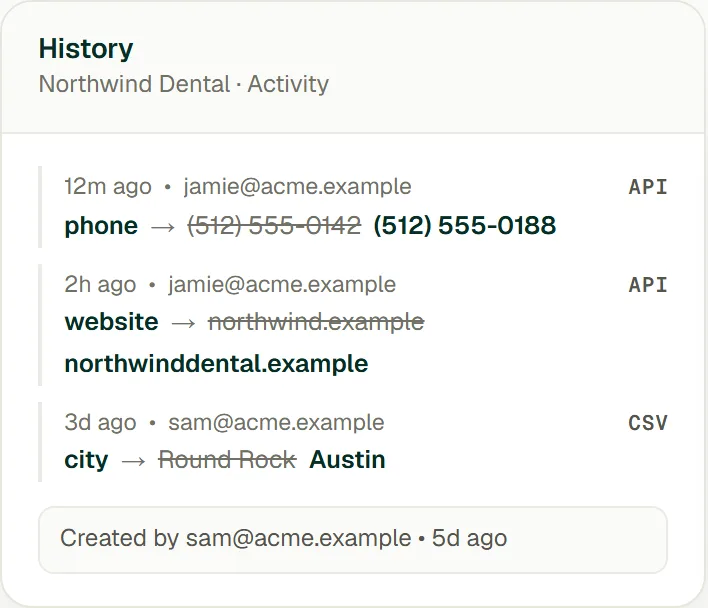
Let AI draft and remember, and let people commit. An assistant is good at preparing the follow-up, summarising the last call and finding who has gone quiet. Prices, dates and promises should still be confirmed by a named person, because that is the part the customer is trusting.
Speed still matters
Closing the gap is not only about keeping promises. It also starts with the first reply, and how quickly it arrives sets the tone for everything after. This short video looks at response speed from a sales team’s point of view; the same logic applies to a five-person business answering its own enquiries.
Frequently asked questions
Is the follow-through gap the same as response time? No. Response time is how fast the first reply goes out. The follow-through gap covers everything promised after that reply, which is where most small businesses actually lose the customer.
What is a good follow-through rate? There is no published benchmark yet, which is why it is worth measuring your own. Track the same twenty-promise exercise once a month and watch the direction rather than the number.
Do I need a CRM to close it? Not to start. A shared list with an owner and a due date for every promise closes most of the gap. A CRM helps when the list gets long, when several people share customers, or when you want the tasks, history and invoices in one place. Our speed-to-lead playbook covers the first reply in detail.
Written with these teams in mind: agencies and studios , field services , professional services .