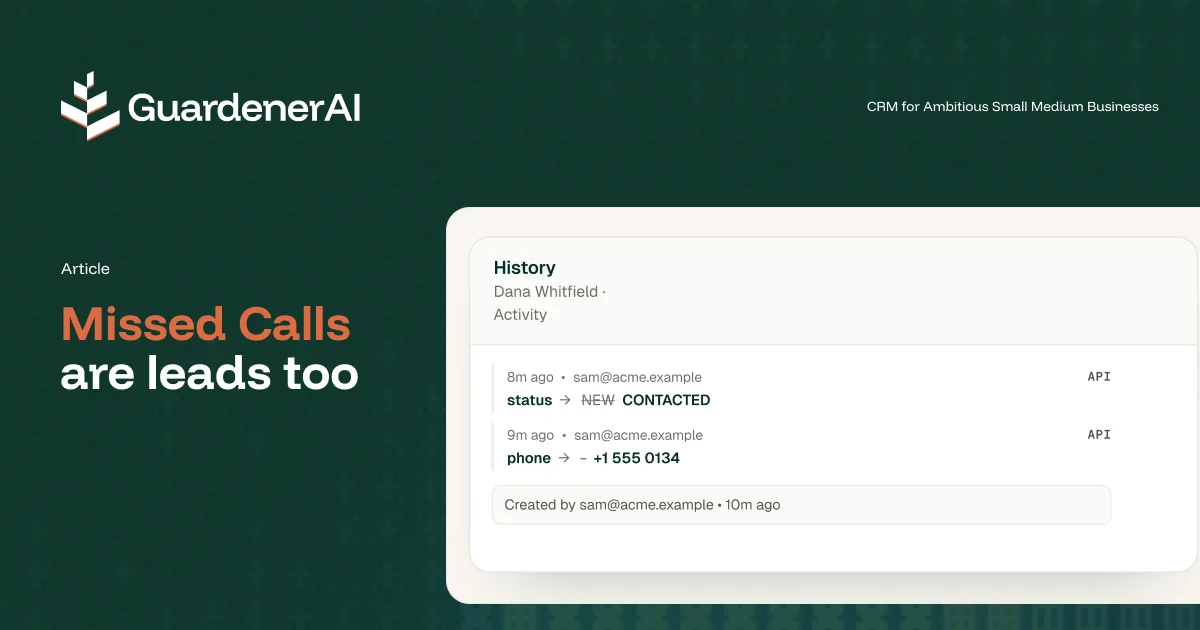
A missed call is a customer who wanted something from you at the moment they rang, so treat it like any other enquiry. Write it down within the hour, put one person’s name on it with a time to call back, and if nobody picks up, try once more by text before the day is out. Logging the call is the step most small businesses skip, and it’s the step that keeps the call from disappearing into somebody’s recent-calls list.
Why missed calls slip through
Think of a plumber under a sink at 10:15 when the phone buzzes in their pocket. They see the number, mean to ring back at lunch, and by lunch there have been three more calls. The 10:15 caller has rung someone else by then.
Missed calls get lost for dull reasons:
- They live on one phone. Only the person holding the phone can see the recent-calls list, so nobody else in the team knows the call happened.
- They scroll away. A busy morning pushes a missed call off the first screen, and after that it might as well never have happened.
- They have no name on them. A number with no name and no voicemail is easy to put off, because you don’t know whether it’s a new job or a wrong number.
- Nobody owns them. If the call came in on a shared line, everyone assumes someone else is calling back.
None of this is about effort. Taken together, a missed call has no owner, no deadline and only a number to go on.
What to log for every missed call
Every missed call gets one line in the place your team already works from. Keep it short enough that writing it takes less than a minute.
| Field | Example | Why it matters |
|---|---|---|
| When | Tue 10:15 | Lets you call back while they still remember ringing you |
| Number | +1 555 0134 | Sometimes all you have |
| Name, if known | Dana, from the voicemail | Turns a number into a person |
| What they wanted | ”Leaking boiler, Northwind Street” | Lets whoever calls back open with the right question |
| Owner | Sam K. | One name, never “the team” |
| Call back by | Today 13:00 | A deadline you can actually miss |
| Each attempt | 12:40 no answer, text sent | Stops two people calling the same person |
The “each attempt” line matters more than it looks. When the customer finally calls back, whoever answers can see who has already tried and what was said.
The call-back routine
- Log it within the hour. Even a bare number and a time is enough to start.
- Call back the same working day. The sooner you ring, the more likely they still need you and haven’t booked anyone else. Our piece on how fast to reply to an enquiry goes into why speed matters.
- No answer? Leave a short voicemail and send a text. Say who you are, that you’re returning their call, and the best time to reach you. Some people won’t answer an unknown number but will read a text.
- Try again the next day, at a different time of day. Someone who can’t pick up at lunch may be free at 17:30.
- Close it on purpose. After a few tries with no answer, mark it as tried and closed, so nobody wonders about it next week.
- Once you reach them, make it a real record. A new customer becomes a lead with an owner. An existing customer’s call goes on their record.
Let your voicemail greeting do some of the work
Your greeting is the first thing a caller hears when you can’t pick up. A good one tells them they’ve got the right business, asks them to leave a name and a reason, and says when they’ll hear back, as long as you actually ring back by then. That message is what makes the “what they wanted” column possible.
This short video is a small business owner’s take on the greeting.
How to log missed calls in GuardenerAI
GuardenerAI is not a phone system. It doesn’t see your calls and doesn’t capture missed calls on its own. What it gives you is one place for the team to log calls, so they stop living on one person’s phone.
- Log the call as a task. From a lead or person, use New task, set Type to Call, give it a due time and an assignee, and write what they wanted in the description. When you ring back, set the Outcome: Connected, Voicemail or No Answer.
- Or ask the assistant. In the chat, type something like “create a task to call back Dana on +1 555 0134 by 13:00 about a leaking boiler, assigned to me”. The assistant creates the task. You set the Type and the Outcome on the task itself.
- Turn new callers into leads once you have an email. A new lead needs a first name, last name and email. If all you have is a number, log the call as a task first and create the lead when you reach them.
- Hand it over cleanly. Give the lead an owner, or use a shared queue so whoever is free can claim it.
The honest limits: there is no click-to-call, call recording or call tracking, and a task’s reminder time doesn’t send an alert. Build the check into the day instead: open your tasks at fixed times, such as late morning and mid afternoon, and work the call-backs that are due.
Check it once a week
Look back at last week’s missed calls and ask three questions:
- How many were logged? If the answer is “I’m not sure”, that’s the first fix.
- How many got a call back the same working day?
- How many did we actually reach? If few, try different times of day or add a text.
Five minutes on a Friday is enough to see where calls are getting lost.
Frequently asked questions
Should I call back or text first? Call first, because a conversation answers questions a text can’t. If they don’t pick up, send a text straight away, since some people screen unknown numbers but read every message.
Do I need call tracking software to do this? No. A shared log and a habit of writing every missed call down within the hour covers most small teams. Call tracking helps when you advertise heavily and need to know which ad made the phone ring.
What if the caller didn’t leave a name or a message? Log the number anyway and call back once. If it was a real enquiry, you’ve saved it. If it was a wrong number, it took two minutes. For deciding which enquiries deserve the most time once you reach them, see what lead qualification is, and our speed-to-lead playbook has a follow-up cadence for after the first conversation.
Written with these teams in mind: field services , healthcare practices , professional services .