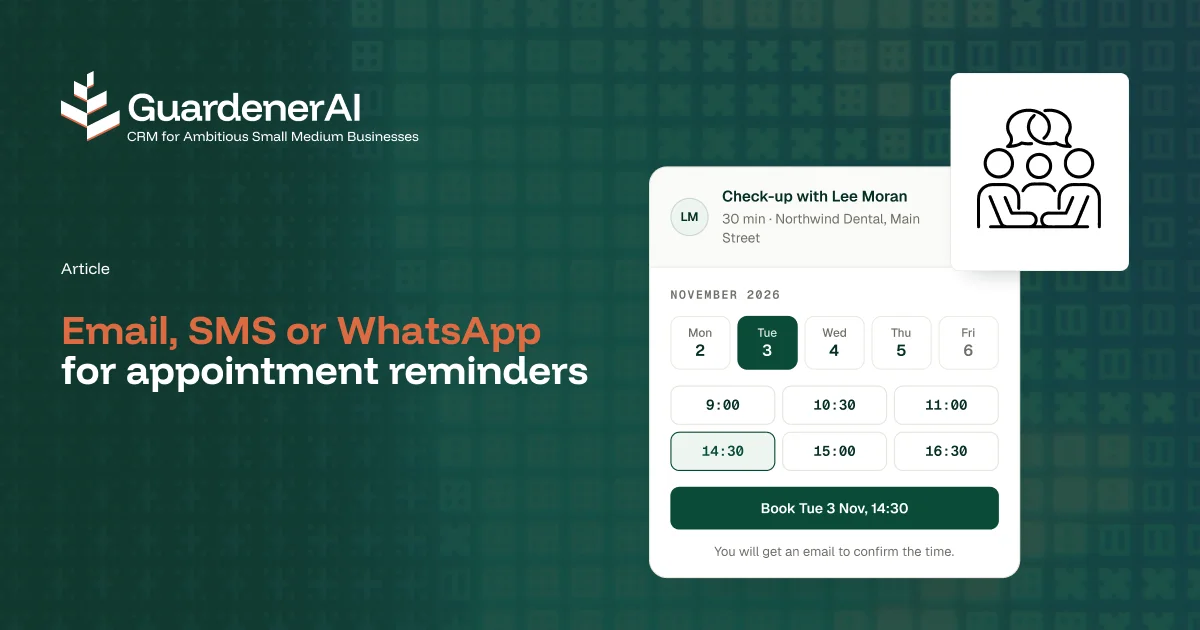
Use email for the booking confirmation and SMS or WhatsApp for the reminder. The email holds the details, the calendar invite and the link to change the booking. The reminder is a short message the day before, and it goes to the phone because that’s where people see it in time. Whichever channel you pick, the wording matters as much as the channel: date, time, place, an easy way to cancel, and why turning up matters.
What the research says about text reminders
Most of the careful research on reminders comes from healthcare, where missed appointments are counted closely. Two findings are useful for any business that takes bookings.
A Cochrane review of mobile phone messaging reminders pooled randomised trials up to August 2012 and found that text reminders improved attendance compared with no reminder. They worked about as well as reminder phone calls, and two of the studies found that texts cost less per attendance than calls. The review rates that evidence as low to moderate quality, which is a fair warning not to expect miracles.
A pair of hospital trials published in PLOS ONE by Hallsworth and colleagues then tested the wording of the text itself. Same channel and timing, different words:
| Reminder wording (trial 1) | Missed appointments |
|---|---|
| Date and time, “call the number on your appointment letter” | 11.1% |
| Date and time, with the phone number written in the text | 9.8% |
| “We are expecting you”, plus “9 out of 10 people attend” | 10.0% |
| “We are expecting you”, plus what a missed appointment costs | 8.4% |
The authors concluded that missed appointments “can be reduced, for no additional cost, by introducing persuasive messages to appointment reminders.” Two lessons carry over to a salon or a clinic. Put the number to call right in the message, and say plainly that the slot is held for them.
Which channel for which message
| Message | Channel | Why |
|---|---|---|
| Booking confirmation | Holds the details, the calendar invite and the change link, and gets kept | |
| Reminder the day before | SMS or WhatsApp | Short, and read in time |
| Early morning appointment | A text the evening before | A same-day message may arrive after they’ve left |
| Change or cancellation | Email, plus a text if it’s the same day | Email for the record, a text so they don’t travel for nothing |
| After a no-show | One polite message offering a new time | The aim is a rebooking, not a telling-off |
For a wider view of the three channels beyond reminders, see email, SMS or WhatsApp: which channel for which customer message.
SMS or WhatsApp?
Both work for a reminder. The choice comes down to your customers and your setup.
- SMS reaches any mobile phone. No app, no account, no data connection. It suits customers of every age and areas where WhatsApp is not the norm.
- WhatsApp is where many customers already chat. It allows buttons such as Confirm and Reschedule, and in many countries it’s the app people check first.
- WhatsApp has rules for business messages. A message you send first has to use a template approved by Meta. A reminder about a booking the customer made is what the utility category is for, but Meta’s categorisation rules treat a template that mixes a reminder with a promotion as marketing. Keep the reminder a reminder.
- Consent still applies. A reminder for a booking the customer made is a service message, which many places treat differently from marketing, but the rules vary by country. Our explainer on opt-in consent covers the basics.
If you can’t decide, use SMS for everyone and offer WhatsApp to customers who already message you there.
What to write
Keep it to a few lines. Here is a reminder for a dental practice, built on the trial’s best wording:
Hi Pat, we’re expecting you at Northwind Dental tomorrow, Tue 3 Nov, at 14:30. Your slot is held just for you. Can’t make it? Call +1 555 0199 and we’ll offer it to someone waiting.
What each part does:
- Their name and your business name, so it doesn’t read like spam.
- Day, date and time in full. “Tomorrow, Tue 3 Nov, at 14:30” avoids any mix-up about which Tuesday.
- “We’re expecting you”, which makes the booking feel like a commitment rather than a suggestion.
- A number to call, written out. The trial’s wording with the number in it did better than “call the number on your letter”.
- Why it matters, phrased kindly: someone else could have that slot.
Leave out offers, links to your shop and anything else that turns a reminder into marketing. On WhatsApp that can get the template recategorised, and on any channel it teaches people to skim your reminders.
When to send
Send the confirmation as soon as the booking is made, and the reminder the day before. A day’s notice leaves time to rebook the slot if they cancel. For appointments booked weeks ahead, an extra reminder a week before can catch people who have forgotten altogether. Avoid sending at night: a reminder that buzzes at 23:00 annoys people more than it helps.
How it works in GuardenerAI
Booking links in GuardenerAI Meetings handle the email side. When a customer picks a time, they get an email from your connected mailbox to confirm it, with a calendar invite and a link to reschedule or cancel. Each change is confirmed by email too. A meeting’s status can be set to No Show, so you can see who missed what.
The honest limits: GuardenerAI does not send reminders before a meeting on its own, and a marketing journey can’t wait until a set time before an appointment. What you can do is send the reminder yourself as part of a short daily routine:
- Each afternoon, look at tomorrow’s bookings.
- Add those people to a journey that starts with I add them and has one step: send the reminder by SMS through Twilio or by WhatsApp.
- For WhatsApp, start from the ready-made Appointment reminder template, which comes with Confirm and Reschedule buttons, and submit it to Meta for approval.
Replies to reminders don’t show on the customer’s record or update the meeting yet, and SMS replies aren’t captured at all. So write the reminder so that changes go through a phone number or the link in the confirmation email, as in the example above.
This podcast episode is a conversation with Michael Hallsworth, one of the authors of the reminder trials above.
Frequently asked questions
Is one reminder enough? For most appointments booked within a week or two, one reminder the day before is enough. For bookings made weeks ahead, add one a week before.
Should I ask customers to reply to confirm? Only if someone reads and acts on the replies. Otherwise give them a number to call or a link to change the booking, which is what the trials found works.
Do reminders annoy customers? A short, useful message the day before rarely does. What annoys people is repeated reminders, late-night sends and reminders stuffed with offers. For the step before the booking, see our booking link explainer.
Written with these teams in mind: healthcare practices , professional services , salons and spas .